
On ice
Visiting a friend a few months back, our discussion turned to our belief in the Bible, which for my friend is somewhat different to my own. He stated his own belief that the scriptures as recorded in the original languages could be regarded as the word of God, and generally ‘infallible’, but that the same could not be said of the scriptures in English. As I touched on in another article recently, that raises some difficult questions for me. (As the number of these articles I have written increases, I find myself returning to some themes and perhaps repeating myself, however, I have heard that repetition is the basis of good instruction – so while such a phrase as ‘instruction’ is somewhat condescending if taken as my own, nonetheless if and when it is God who speaks then I expect it does not hurt to hear the same thing more than once.)
Was God able to communicate his perfect word and arrange its transcription into the Hebrew and Greek languages but not into English? Or if God was able do that, but chose not to, what might be his purpose in presenting a perfect, written word to some but not a great many others who happen to speak a different language?
If I can impart nothing more from this article, then it would be this exhortation: ask questions.
Much is not as it seems in our world, or in the Church, and it does not hurt to ask questions with an open mind, and especially to ask of our Lord who is the Truth. (To ask questions for the purpose of undermining what, with an honest mind, we might already know to be true, I do not advocate.)
‘Call unto me, and I will answer thee, and shew thee great and mighty things, which thou knowest not.’ (Jeremiah 33:3)
‘If any of you lack wisdom, let him ask of God, that giveth to all men liberally, and upbraideth not; and it shall be given him.’ (James 1:5)
However we view scripture, I have found that the meaning of the scripture prevails and puts us in a perilous position when we begin to suggest shortcomings of translations and so on as reasons why certain things found in the written word need not be heeded.
For example, my friend stated he had heard a view that the years of scripture might each be viewed as thousands or millions of years when it comes to the supposed age of the earth, rather than any literal position of belief that the earth may be only a few thousand years old in total, as would seem to be suggested by the Bible (through consideration of genealogies and lengths of generations of people described in the Bible). And the phrase my friend used was, he was ‘more comfortable’ with the former belief which allows for millions of years of earth history. Others have suggested that support for such a view might be found in scripture such as the following:
‘But beloved, be not ignorant of this one thing, that one day is with the Lord as a thousand years, and a thousand years as one day.’ (2 Peter 3:8)
When it comes to the history of the world it seems to me the length of it is not so important as what has happened in that history, and pre-history if there is any such thing (seeing the scriptures start at ‘the beginning’ – Genesis 1:1). And if God were to say to me at such time as I will stand before him, ‘you got that matter of the old earth very wrong; in fact, it was indeed millions of years old’, then I would not be at all surprised and I think it would be the least of my errors. Because these matters of timings and technicalities often appear different in hindsight once it is understood how things in truth unfolded, and timings are not at the forefront of what God reveals to us.
‘And he said unto them, It is not for you to know the times or the seasons, which the Father hath put in his own power.’ (Acts 1:7)
However, again, these matters raise other, more important questions.
What is this ‘comfort’ my friend spoke of, which encourages him to allow for millions of years of earth history? Does that simply mean, a great many people believe such things, therefore it seems unlikely that so many could be wrong about such a thing?
It appears to me that the Bible is not widely believed at all in my country; therefore, if it is true in any sense (and I believe it is true in every sense) then that would seem to indicate firstly that the majority of people can be wrong about important things, and secondly, if I disagree with the majority about something so important to me (and to my friend) why should I feel any ‘comfort’ in agreeing with them about some particular part e.g. the age of the earth?
‘And the light shineth in darkness; and the darkness comprehended it not.’ (John 1:5)
‘And we know that we are of God, and the whole world lieth in wickedness.’ (1 John 5:19)
The Biblical world view is that men are very widely deceived about the basic facts of our existence, and all things which concern us, and that few hold closely to the truth.
‘Enter ye in at the strait gate: for wide is the gate, and broad is the way, that leadeth to destruction, and many there be which go in thereat: Because strait is the gate, and narrow is the way, which leadeth unto life, and few there be that find it.’ (Matthew 7:13-14)
The majority views of our world are not a good place for believers to seek comfort by agreement with those.
‘But when the Comforter is come, whom I will send unto you from the Father, even the Spirit of truth, which proceedeth from the Father, he shall testify of me:’. (John 15:26)
Jesus is the Truth, and his truth is not limited to ‘spiritual’ or religious matters; all truth is of God. The world, therefore, is largely ignorant of the truth (being ignorant of our Lord) and likewise we should not assume worldly ignorance is limited to ‘spiritual’ matters.
It is true that much knowledge has been discovered by godless men and has been found to be true indeed. However, much of that knowledge has no bearing on our moral conduct or spiritual state, or any other vested interest, and therefore no temptation weighs upon such scientists and researchers to misrepresent their findings. Whereas, other matters have more relevance to our essential belief in God – and the ways in which that, and other matters from time to time in or out of popular favour, affect our standing in the world, our popularity and success – and it appears to me that matters concerned with those things are indeed widely misrepresented.
For example, the theory of general, biological evolution of species without any abrupt ‘act of creation’ by God is so widely believed by scientists, who also believe it must have taken millions and billions of years (though others now say it happened in relatively brief ‘bursts’ – an even greater impossibility, which the millions and billions of years were originally conceived to overcome, by transporting the whole matter well and truly outside the realms of anything which can be surely known, and therefore beyond actual science) – the need for millions and billions of years to support that other, unsupported theory, which is vital to the unbelief the world clings to, has led to the theory itself (evolution) being put forward as one reason why the millions and billions must be so. In other words, a circularity. We have decided, irrationally to believe in evolution (so that we might not believe in God) therefore we need those endless years to have taken place, and therefore we state categorically that they have – because evolution requires it, and is therefore supposedly evidence of it.
So, the further question that all these matters raise is, if we are to disregard some matter of the Bible because it is at odds with the widely held beliefs of our godless world – of what then can we be sure?
If we are now the self-appointed arbiters of the truth, and can pick and choose what we believe – how are we then in submission to the truth? If we have made ourselves lords over it?
If we are qualified to judge the Bible, and to discount certain aspects, why refer to it at all if our own knowledge and judgement is superior?
But concerning the Biblical record, it is true that a mathematical assessment of the various genealogies and ‘generations’ is a less than certain method to arrive at an absolute age for the earth. And seeing that the age itself is not directly stated, one does question whether it was the purpose of God that we should know it in specific terms. However, concerning the creation, God spoke to Moses as follows:
‘Six days shalt thou labour, and do all thy work: But the seventh day is the sabbath of the LORD thy God: in it thou shalt not do any work, thou, nor thy son, nor thy daughter, thy manservant, nor thy maidservant, nor thy cattle, nor thy stranger that is within thy gates: For in six days the LORD made heaven and earth, the sea, and all that in them is, and rested the seventh day: wherefore the LORD blessed the sabbath day, and hallowed it.’ (Exodus 20:9-11)
It is beyond the scope of this article to address the place and significance of the Old Testament law, except to say that New Testament believers, especially who are not of Israel, are subject to none of the Old Testament laws according to the letter, and indeed no laws at all of that type.
‘All things are lawful for me, but all things are not expedient: all things are lawful for me, but all things edify not.’ (1 Corinthians 10:23)
But it is clear from the above scripture that in speaking to Moses, God spoke clearly of seven, literal days, because that is how he required his statement to be understood by Moses, in order that Moses and all Israel should keep the sabbath – a literal day. To suggest that God in fact meant millions of years and that Moses was deceived when he took God at his word in speaking of six days, and of the seventh day, the sabbath, is to depict God as misleading Moses, and not as the Truth, which he is.
‘At that time Jesus answered and said, I thank thee, O Father, Lord of heaven and earth, because thou hast hid these things from the wise and prudent, and hast revealed them unto babes. Even so, Father: for so it seemed good in thy sight.’ (Matthew 11:25-26)
In similar fashion therefore, Moses understood God in a childlike way, and so God intended it. The Biblical view is that God created the heaven (the ‘firmament’, apparently the sky or atmosphere as identified in Genesis 1:6-8) and the earth, including the sea, and all the creatures and other things described in Genesis 1, and mankind, in six, literal days. The length of those days is not known, but they were not years in length, because a year is made of many days.
Many years ago while working in the School of Earth Sciences at Victoria University of Wellington, I encountered a challenge to my literal belief in the Bible. To give the background, I had already determined many years earlier while studying for my undergraduate degree that there appeared to be no obvious, scientific reason why the Bible must not be literally true. There were interpretations of science widely held which contradicted the Bible, but these were not conclusive. If one was inclined to take a literal view of the Bible, there was scope to do that without disregard for ‘the facts’.
For example, all forms of radiometric dating which are used to determine ages of objects which exceed a literal, Biblical timescale, rely on assumptions about the state of isotopes and their rates of decay in the distant past for which there are no measurements. (It seemed to me from my own study of the Bible that the age of the earth must be in the thousands, not millions of years, according to the Biblical genealogies, and a reasonable, approximate ceiling for a Biblical age of the earth might be ten thousand years.) And while the assumptions made by secular Scientists may represent reasonable hypotheses from that perspective, they are by no means certain. For example, if God made the earth as described in Genesis in six days, what processes of the creation and decay of isotopes might have accompanied that? Certainly, and almost by definition, not those measured today, seeing that the materials seen today were then in creation, and very rapidly so.
However, many years later at Victoria I came across a piece of literature which presented a new challenge. The paper was one prepared by a lecturer and friend of mine, as I recall for the Business Roundtable, concerning climate change. The idea of climate change was much less familiar in those days but was already touted as having potentially great implications for all spheres of life, including business. These business folk therefore wanted a reliable summary they could understand, and my friend was a renowned communicator and expert in the field. He obliged and prepared the paper. I also was keen to read it because I likewise felt my friend would make a good job of summarizing the emerging science.
In the paper my friend referred to various research, including a paper published in the premier science journal, Nature, which described an analysis of a deep ice core from Antarctica: the Vostok ice core. The purpose of this analysis (as I recall) was to determine concentrations of past, atmospheric gases along the length of the ice core, representing increasing depths of ice from the location where it originated, and due to the incremental accumulation of ice at that location over a long period, and the concurrent exposure of its surface to the atmosphere, the concentrations of gases at times in the past.
My friend described how snow was deposited seasonally at the core site, and how this consolidated into ice, showing an annual pattern of variation similar to the way trees have annual ‘growth rings’ in their trunks. By counting the layers, therefore, the scientists could determine ages for different points or depths on the core. The age determined for the deepest ice was about 390,000 years.
It took a while before the full implications of this research dawned on me with regard to my literal belief in the Bible. Because, as my friend had described it, this was a method of actually measuring the passage of years over a much longer period than my supposed maximum age of the earth i.e. about 10,000 years. It did not depend on assumptions about radioactive decay of isotopes; they had actually counted the annual ice layers, so it was said.
Despite that the age of the earth in itself is not a central tenet of my faith, my literal belief in the Bible has become so. I therefore resolved to investigate this matter of earth dating, in the knowledge that if it was as reported, I would have to revise my whole view of the Bible and by consequence, my whole ‘world view’. My certainty about everything the Bible teaches about God, about us – about everything – would no longer be sure. It is hard to overstate the personal significance of the investigation I was about to make. And given that my friend was a sincere man, and Nature a journal of the highest reputation, the odds seemed decidedly to favour a finding that I had been mistaken in my views. I braced myself for the onset of fundamental changes to my understanding of the Bible, and of the world.
I soon discovered that the method of ice layer counting was not well described in the journal article. This was a surprise and seemed rather poor form to me, because scientific papers follow a broadly standard format, and description of the methods of the research is one of the important sections. In fact, it is a criterion for papers of good, scientific standard that the methods should be described in sufficient detail and clarity that the research could be repeated by a suitably qualified person in the right circumstances. Such is the dogma of science.
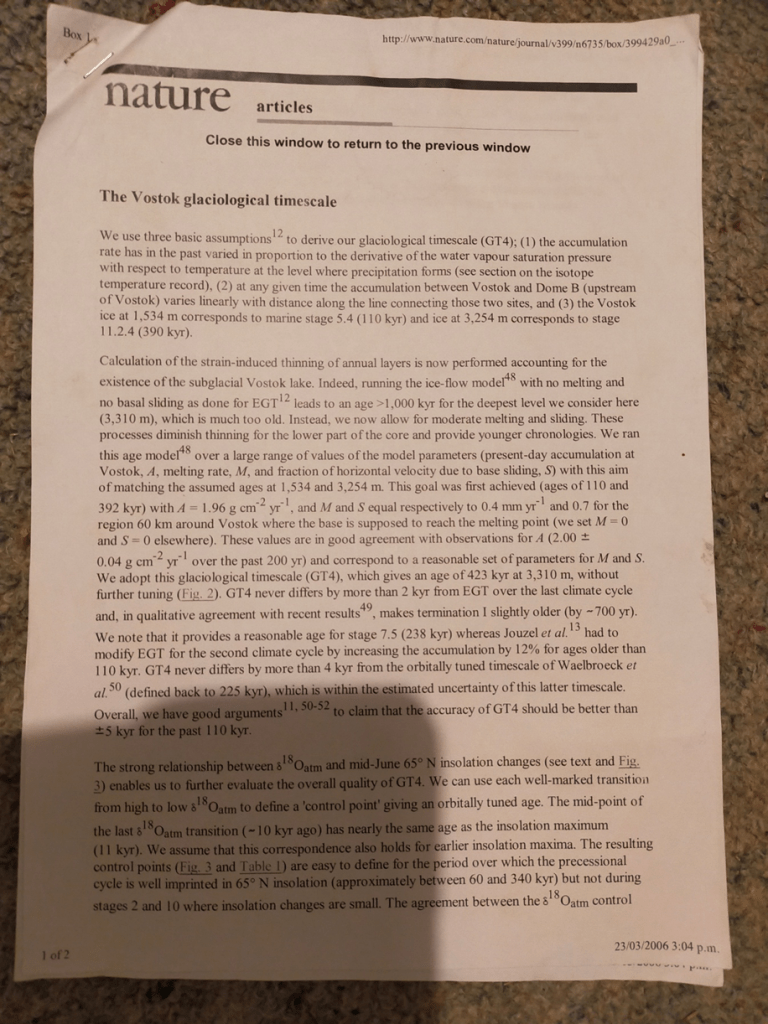
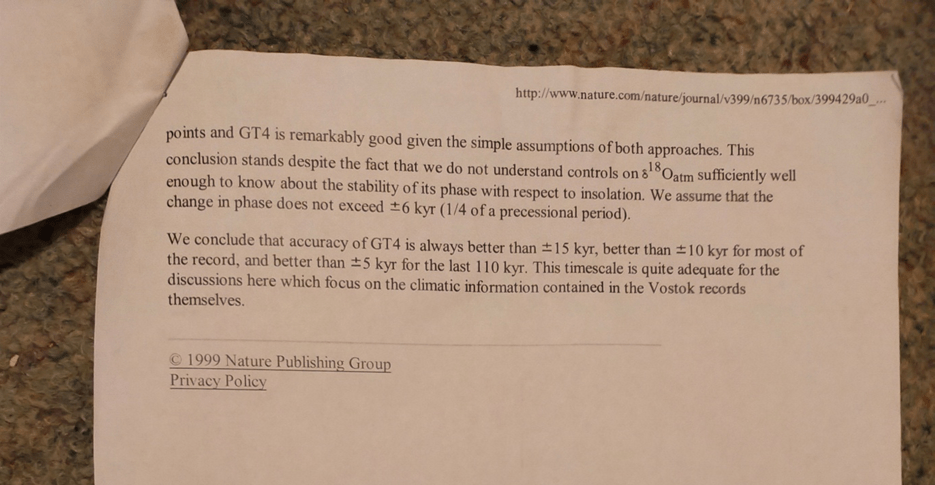
It was not clear to me if, or how, the scientists had counted the ice layers. And as the whole findings of the paper concerned physical states at certain times in the past, and this supposedly was the method by which this had been determined, for this reason also it seemed poor form. However, by following footnotes and links from links, I eventually found a record of the method. I have appended a picture of it to this article, because it became a milestone in my journey of faith.
In fact the scientists had not counted the layers of ice as my friend supposed. Because, unsurprisingly, the annual patterns from deep in the ice and from long ago had become compressed and obscured. It had been necessary for the scientists to attribute periods of time to the core according to lengths or depths without actual annual variation being visible, and to estimate to what extent the ice had been compressed at different depths. Already this meant that my position on the Bible – that uncertainty of science was sufficient to allow for a literal belief – remained tenable. There was no actual record of ice layers older than a few thousand years. However, I was curious to know how, if not by counting the layers, the scientists had determined the age of the core along its length, and particularly at its greatest depth, corresponding to its oldest part.
At this point the science departed beyond my own ability to readily understand the details (and more links led to ever more complicated connections) however, I understood that the length-age relationship was determined from mathematical models incorporating elements such as thinning, melting and ‘basal sliding’. No doubt a sophisticated understanding of these phenomena was held by those concerned. I noticed the re-appearance of isotopes in the overall estimates and assumptions. And according to their initial, best efforts, the scientists had determined an age for the core of over one million years. However, they reported, they ‘considered this much too old’ – and therefore set about tweaking their model until it reported to them their assumed age for the core, based on other assumptions and research, of about 390,000 years.
No wonder this method was buried beyond the gaze of non-initiates such as myself, who might unhelpfully pry into matters beyond our station. I concluded the Vostok ice core research reported in Nature contained no actual determination of any earth ages whatsoever, only pre-determined reflections of other research adopted to ensure consistency with that research, in itself based on other assumptions of which I know nothing.
How extraordinary – that the primitive faith of a simpleton such as myself should survive the academic onslaught of my most educated friend’s writing, and the academic might of Nature, and emerge as remaining entirely reasonable to an honest enquirer.
How good, and how true is our God!
Praise to our Lord, who has ‘revealed these things unto babes’!
Amen and amen.
 wilderness99